A place to discuss member's DIY audio projects & post pictures/schematics. NOTE: There is a limit of 2MB per attachment, and a maximum of 3 attachments per message. If you need to post more than 3 attachments, just add another message.
May 4th, 2016, 9:14 am
Also, the sensitivity increase isn't linearly additive with an increased number of drivers. If it was, an array of 8 compression drivers would have a power efficiency of >100% which is, of course, impossible...
Roscoe
May 4th, 2016, 9:18 am
It goes up by a factor of 6dB for a doubling of drivers (or 20 Log(N)). The drivers have to couple like in a line array application.
May 4th, 2016, 9:31 am
As Tomp stated, that's VOLTAGE sensitivity, NOT power sensitivity, which only increases by 3dB. And, as I mentioned, you can't just keep adding drivers without limit and continue to have an increase in power sensitivity as the power efficiency can't go over 100% (you can't get more than 1w acoustical power out of 1w electrical power in).
Roscoe
May 4th, 2016, 10:23 am
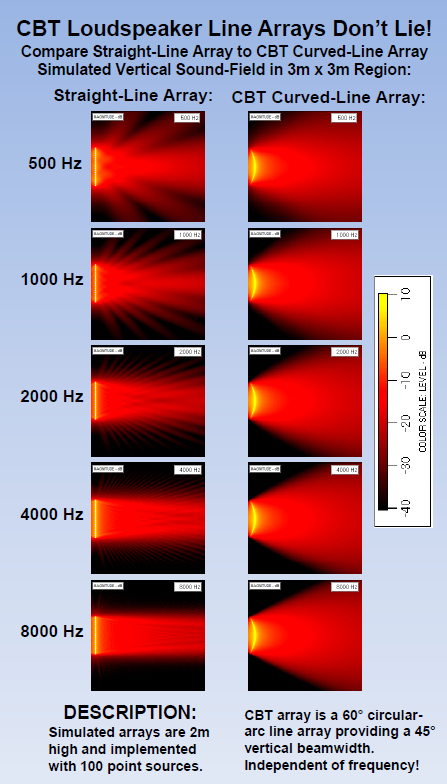
Probably a more interesting thing to do with the array and multiple amps would be to use time delay with individual sections. You might be able to duplicate what Don Keele does with his Constant Bandwidth Transducer. Take a look at the plots of his technique vs a line array composed of individual drivers:
http://www.xlrtechs.com/dbkeele.com/ima ... 0Large.png If a line source is not a true line sourcce, that is an uninterrupted diaphragm, as the wavelengths of the frequencies reproduced get close to the spacing between drivers, comb filtering occurrs. Using time delays can mitigate that effect. It can also be used to steer the sound in different directions as they do in auditoriums with line arrays.
Tom
May 4th, 2016, 10:51 am
I am really referring to the acoustical SPL output of the array of drivers goes up every doubling of drivers. I think of that as the sensitivity increase. In array theory it is called Directivity Index, which is DI = 10 Log(N) (dB), where N is the number of drivers if they are point sources. That is 3dB/doubling of drivers for the array. That is the acoustical coupling of the drivers is below the 1/4 wavelength frequency of the driver spacing.
The two definitions of Sensitivity are either dB SPL/1w/1m or dB SPL/2.83Vrms/m, for the equivalent into an 8 ohm driver of 1 watt. I am just referring to that style of definition for power. The acoustical output goes up by 6dB/doubling of drivers (20 Log(N)).
Since the line array is also a cylindrical radiator, the spatial loss is 3dB per doubling of distance instead of 6dB for a spherical radiation pattern. This would be 6dB more SPL at 4 meters for the listening position.
These are my references, so maybe confused.
May 4th, 2016, 11:11 am
HAL wrote:I am really referring to the acoustical SPL output of the array of drivers goes up every doubling of drivers. I think of that as the sensitivity increase. In array theory it is called Directivity Index, which is DI = 10 Log(N) (dB), where N is the number of drivers if they are point sources. That is 3dB/doubling of drivers for the array. That is the acoustical coupling of the drivers is below the 1/4 wavelength frequency of the driver spacing.
The two definitions of Sensitivity are either dB SPL/1w/1m or dB SPL/2.83Vrms/m, for the equivalent into an 8 ohm driver of 1 watt. I am just referring to that style of definition for power. The acoustical output goes up by 6dB/doubling of drivers (20 Log(N)).
Since the line array is also a cylindrical radiator, the spatial loss is 3dB per doubling of distance instead of 6dB for a spherical radiation pattern. This would be 6dB more SPL at 4 meters for the listening position.
These are my references, so maybe confused.
The real definition of sensitivity refers to power. The reference to voltage is a marketing ploy because at lower impedances the same voltage results in more power. When the SPL is recalculated with the power reduced (ie voltage reduced) to the same power as the higher impedance driver the lie is exposed. BTW, I'm surprised that you are so worried about sensitivity and SPL. From what I have seen you will not have any problem generating lots of sound from this system. I would be more worried that using a lot of power on each line driver will run them out of linear excursion or power handling. With as many drivers as you have coupled with the fact that you will be in the near field I don't think you will have trouble developing very satisfactory SPLs.
Tom
May 4th, 2016, 12:40 pm
Tom,
That is my understanding as well from the sensitivity definitions.
I am not worried about the sensitivity with the BG drivers. The FPS planars are the issue when you try to do the room and speaker correction to flat. They needed 18dB of correction range, and run out of capability. I picked the BG's for the increased output capability and to use the small amps per driver. They need about 10dB of correction range.
Just pointing out some of the ideas that went into the speaker, so folks understand the concepts.
May 4th, 2016, 2:17 pm
I have found out when trying to "balance" a lot of rooms and speakers that when you get into the range of 18 dB of correction it will not work out right. Doing that will generally result in major problems with some parts of the listening area that behave differently. My general procedure is to first do the quaisi anechoic measurements to see how the speakers behave above around 300 Hz which is typical for normal room early reflections. I will make some adjustments for those results. Next I take a lot of measurements using individual sine wave frequenciesfrom low bass to high treble in aroud 8 - 10 spots around the prime listening area. I enter those into a spread sheet and then drop out any readings that are more than about 6 - 8 db from a guesstimate average. After those are removed I do a mathematical average and make adjustments to offset the peaks and suck outs. Remember suck outs are aptly named and are virtually impossible to deal with electronically if they are high Q. After all that I listen and it always takes final tweaking using a lot of material that is representative of what I listen too. Make sure you pick some poorly recorded pieces as well as you may have to temper the setup or have other stored EQs to make that stuff listenable. Measurements get you in the ball park but you may be in left field and have to do a lot of listening to get across home plate. Just like baseball, using EQ to make major swings usually results in a strike out.
Tom
May 4th, 2016, 4:00 pm
Tom,
That is why the 6 driver FPS array will not work out. A 10 driver array might, but I think the adjustment range will still be 18dB. Will have more acoustic output, but probably will not be enough for the correction.
Good advice. Will try that as well as the measurement cube and see what happens. Luckily all the averaging is done by Room EQ as part of the measurement process. It measures both right and left channels independently at up to 20 positions and then coherently sums them together. It then corrects the minimum phase portion of the measurements average.
I am only going to correct the system at the listening location as that is the only real listening seat in the room. The other sofa is facing 90 degrees to the music.
Next batch of speaker cables is done and ready to connect to the BG Neo10's and amps once I can install the drivers in the baffle.
Will see how this all works hopefully this weekend.
May 4th, 2016, 10:23 pm
tomp wrote:Probably a more interesting thing to do with the array and multiple amps would be to use time delay with individual sections. You might be able to duplicate what Don Keele does with his Constant Bandwidth Transducer. Take a look at the plots of his technique vs a line array composed of individual drivers:
http://www.xlrtechs.com/dbkeele.com/ima ... 0Large.png If a line source is not a true line sourcce, that is an uninterrupted diaphragm, as the wavelengths of the frequencies reproduced get close to the spacing between drivers, comb filtering occurrs. Using time delays can mitigate that effect. It can also be used to steer the sound in different directions as they do in auditoriums with line arrays.
Tom
Tom,
I have a time domain beamformer running in the DSP XO now. Very simple and seems to work from listening in the vertical plane at different heights. Did not hear any comb filter effects from the FPS planar array. Problem was could not go to normal listening levels due to the very low sensitivity.
It is symmetrical about the center of the array for the time delays. This is not Don's style of beamforming. More like a standard vertical line array of hydrophones focused on the center axis.
Powered by phpBB © phpBB Group.
phpBB Mobile / SEO by Artodia.